A Rainy Afternoon, One Gallery Room, Three Ways to Look
A three-pass gallery visit helps you notice composition, materials, and placement while keeping your attention on the room rather than your phone.
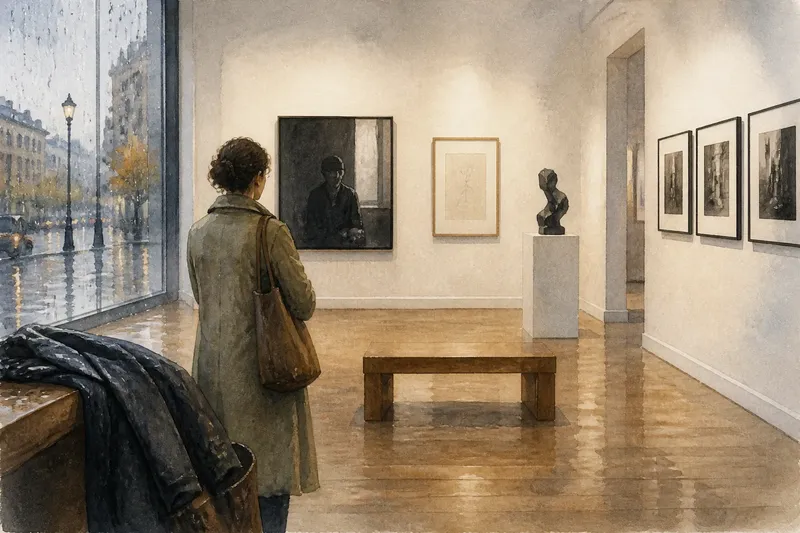
Rain taps the gallery windows while your damp coat hangs over one arm. In the first room, a painting, a small sculpture, and a row of photographs seem to ask for attention at once. A three-pass gallery visit gives the room a simple structure: first map where things sit, then look at their materials, and finally compare how the works occupy the room together.
This routine suits one room and an unhurried afternoon. It is not a hunt for hidden meanings or a test of art vocabulary. Each pass gives your eyes a different task, so details that were present all along have a chance to register. If the room is busy, shorten a pass or step aside; careful looking does not require occupying the best spot for half the afternoon.
Map the room before choosing a work
Pause near the entrance or another place that leaves the main sightlines open. Notice the doorway, windows, benches, and wall breaks. Are the works arranged in a line, gathered into a cluster, or spaced so each has its own patch of wall? The room sets the conditions for looking: a narrow passage feels different from an open floor, even before you focus on an individual piece.
Take a slow look around. Notice where your gaze lands first, then where it goes next. One work may stand out because it is large, brightly colored, or placed at the far end. Smaller pieces may form a quieter group. You are not deciding whether the arrangement succeeds; you are recording what catches your attention and what stays in the background.
If a bench is available, sit for a moment and compare that view with the one from the doorway. A work at eye level may feel different from one mounted higher or placed low. A side angle may reveal a shape hidden from the center of the room. Keep one such change in mind for the next pass.
Follow the arrangement of each work
For the first pass, look at composition: where forms sit, how occupied and empty areas balance, and where lines or edges direct your attention. In a photograph, that might be the distance between a figure and the frame. In a sculpture, it might be the relation between a solid mass and the space around it. A group of objects can have an arrangement too, especially when their placement makes one feel like a beginning or a pause.
Follow the route your gaze takes. Does it land in the center, travel along a diagonal, or return to a small detail near the edge? Notice whether a repeated shape carries your eye between pieces on the same wall. There is no correct route to identify; the useful thing is to notice the one the work offers you.
Then look at the intervals between works. A wide gap can make two pieces seem independent; a tight arrangement can make them feel like parts of a group. The same object may also change character beside a vivid image rather than a quiet one. Your position and the neighboring works contribute to what you see.
Say you enter a room where a dark, square photograph hangs beside a pale drawing. On this pass, you notice that the photograph’s central figure catches your eye first, while the drawing’s open margins slow it down. You step back and see that both works leave a similar strip of empty space near one edge. That is a specific observation; it does not require a claim about either artist’s intention.
Look at materials from a comfortable distance
For the second pass, move closer only where the room allows it and without crowding other visitors. Notice how materials catch light, hold an edge, or mark a surface. A matte print absorbs attention differently from glossy paper. A woven piece may show its structure through repeated crossings, while a painted surface may reveal strokes, layers, or deliberate smoothness. You do not need to identify every process.
Pay attention to what a material permits and what it seems to resist. A folded sheet can keep a crisp ridge or sag into a softer curve. A metal object may carry a polished highlight, a dull finish, or both. In a photograph, paper and lighting can affect how deep the dark tones appear. These are observations from a visitor’s distance, not a conservation report.
Light belongs in this pass because it changes what materials disclose. Notice whether a reflection shifts as you move, whether a sculpture’s shadow makes an outline on the wall, or whether an image looks flatter from one angle. If a detail is beyond a barrier or requires leaning too close, leave it unseen. A gallery is not a place to negotiate with a plinth.
Compare related materials without assuming one is more honest or difficult. Two works may use similar paper in opposite ways: one hides the support beneath an image, while another makes folds or edges prominent. The useful question is what becomes noticeable because of the material, and what recedes.
Compare how the works occupy the room
On the third pass, look across the room rather than staying with one object at a time. Find a connection you can point to: a repeated color, a returning shape, a shared material, a similar direction of movement, or a contrast in scale. Then look for a difference that complicates it. If two works both use blue, perhaps one spreads it across a broad field while the other confines it to a small mark. Similarity opens a comparison; it need not settle one.
Placement can create a relation too. Two works facing each other may seem to answer across the room. A small object near the entrance may balance a large work at the opposite end. Change your position before settling on that reading. A relation that seems clear from the doorway may weaken from the side, where another one can emerge.
Also notice what does not connect. One isolated work may interrupt a repeated palette or arrangement, making the surrounding pattern easier to see. Keep the claim modest: “these share a curved line” is something you can check; “these must be about the same thing” goes beyond the visible evidence.
Return to the dark photograph and pale drawing. From across the room, you notice a narrow line in the drawing that echoes the photograph’s frame. Up close, their different surfaces make that resemblance less prominent. The connection remains one possible way to read the pair, not the only one.
Keep the three-pass visit flexible
Begin by orienting yourself, then make the passes in order if the room allows. Let your pace follow the display: a compact room may need brief attention, while a dense installation may call for longer pauses. The point is to return with a different task, not to obey a clock. If the room gets crowded or your attention runs out, step into the next space or sit somewhere permitted.
A notebook is optional. If you enjoy keeping records, write plain observations such as “red shape at left,” “rough edge beside smooth surface,” or “two works face each other.” A phone note works too: dim or silence the screen so it does not distract you. Do not photograph or record anything where the gallery prohibits it; check posted signs or ask staff if the rule is unclear. If writing interrupts your attention, put the notebook away.
- At the entrance: Check whether the room is open or narrow; if a clear sightline is available, use it to map the arrangement, and if not, move to a permitted spot at the edge.
- Before the composition pass: Notice which work first draws your eye; if one dominates, include the quieter works in your route, and if none stands out, begin with the nearest work.
- During the composition pass: Check where your gaze travels through a work; if a line or shape guides it, follow that route, and if the path is unclear, shift your attention to the balance of occupied and empty areas.
- During the materials pass: Notice texture, edges, or reflections from a comfortable distance; if a detail is visible without crossing a barrier, examine it, and if not, leave it rather than leaning in.
- On the room-comparison pass: Check for one visible feature shared by two works; if you find one, look for a difference that complicates it, and if you find none, compare their placement or scale instead.
- Before making a phone note or photo: Check posted rules or ask staff; if photography is allowed, follow any conditions and keep the screen unobtrusive, and if it is prohibited or unclear, do not photograph and use a brief written note only if permitted.
- Before leaving: Notice one detail that changed across your passes; if it remains clear, keep that observation, and if it does not, leave without forcing a verdict.
Labels can answer questions about a medium, a title, or the circumstances around a work, but they are not the only way into a room. If you choose to read one, check what it adds to the specific feature you noticed, then look back at the work. The label may sharpen your attention or leave your first observation unchanged.
What should you do when the room resists the routine?
How long should I spend on each pass?
Give each pass enough time for your attention to shift, without setting a required duration. If you stop noticing anything new, move on or leave the room and return later.
What if the gallery is crowded?
Use a clear edge of the room and wait for a comfortable view rather than pressing close. Compare works from across the space, return when a wall clears, or skip a detail you cannot access.
What if I cannot find a connection between works?
Try a visible feature such as scale, color, orientation, or empty space, then compare a contrast. If no connection feels convincing, note that instead; not every room offers a single organizing idea.
Can I take a photo or make a phone note?
Follow posted gallery rules and ask staff when they are unclear. Do not photograph where it is prohibited; if notes are allowed, keep the screen dim and use it only when it does not block other visitors or interrupt your attention.
Leave with a detail you can still describe
Before you go, take one last look from a place you have not used yet. The entrance may show the room’s arrangement most clearly; a bench may bring a low work into view; a side angle may reveal a relation hidden from the center. Choose one detail that became clearer across the three passes, such as how a rough surface catches light or how two works share a shape while using it differently.
A rainy afternoon gallery visit need not produce a complete interpretation. You may leave remembering a color, a material detail, or a relation that appeared only after crossing the room. Keep the description specific and open to revision. If you return to the gallery, start from a different position; a room can change without moving a single thing.